Wednesday, December 16, 2009

The truth behind the Tiger in the Woods

The truth behind Tiger Woods story, is the media in America is owned by the elites who don't want to draw attention to Barack Obama's troop surge in Afghanistan, the controversy of the Nobel Peace prize and the radical agendas they are proposing in Copenhagen which won't benefit developing nations...

a the truth a so it go...

To quote John Maxwell in the Observer...


"I cannot forget, nearly 20 years ago, Bryant Gumbel blurting out on Good Morning America that the Oklahoma City bombing, then 'just in', must have been the work of Middle Eastern terrorists. Or last week, when Tiger Woods was reportedly 'seriously injured' after gate-crashing a fire hydrant and a tree. The US Press has printed more about that story in a week than it has about Honduras since July or about Haiti in five years." I hope you read this the people need to know!


The media is too concentrated, too few people own too much. There are really five companies that control 90 percent of what we read, see and hear. It's not healthy.
Ted Turner

Any dictator would admire the uniformity and obedience of the U.S. media.
Noam Chomsky

There's less critical thinking going on in this country on a Main Street level - forget about the media - than ever before. We've never needed people to think more critically than now, and they've taken a big nap.
Alec Baldwin

Monday, December 14, 2009

Open Letter to the Western Media (UNPUBLISHED)

The media is too concentrated, too few people own too much. There are really five companies that control 90 percent of what we read, see and hear. It's not healthy.
Ted Turner
Any dictator would admire the uniformity and obedience of the U.S. media.
Noam Chomsky
There's less critical thinking going on in this country on a Main Street level - forget about the media - than ever before. We've never needed people to think more critically than now, and they've taken a big nap.
Alec Baldwin
I am the voice of a generation
Bob Dylan


Greeting once again Montego Bay, after some introspection, rummaging through the remains of the day, I have realized I wrote a slew and rash of Open Letters tackling many of the National Institutions and Government Ministries, and realized that there is one entity or body I failed to tackle and that is the MEDIA. The media in western Jamaica particularly, and the Western Mirror is not exempted from this. For I believe the media in western Jamaica has been lackluster and underdeveloped for too long now. Once people could have escaped under the notion that we are a small demographic without a very intellectual or reading population. Not so anymore. This is the Mobay and western Jamaica of big names, characters and events like Brown Sugar, Usain Bolt, Colin Channer, Jah Cure, Queen Ifrica, Mackie Conscious, Sumfest, ATI Weekend, Jazz & Bluesfest and such. We are now witnessing a growing intellectual community with UWI now officially here and a whole host of other cultural and artistic facets growing fast behind it. Hence it seems odd we have the same floundering fledgling television stations, and only two surviving newspapers of note, and two radio stations.

I believe the western media has been slow in growing fostering and honing great talent. I sincerely believe in the second city lies the next set of big television personalities. I believe Mirror has been long overdue in becoming a western paper, with a western edge and vantage point with NATIONWIDE distribution. I believe western media has also been slow in harnessing new technology and grabbing the new generation’s attention. They have also been slow in reaching deeply and widely into the western Jamaican diaspora abroad. The media out west now needs to be a platform and voice, giving legitimacy and credibility to its talents, writers, columnists, TV personalities, to its audience.

Self-examination by western news and media organizations is always useful and crucial at this junction in Western Jamaica’s growth. In this great future, the Western Mirror needs to mean more to the minds of the people than SUSS and Death notice and Murder updates it is time we seriously go about "Preserving Our Readers' Trust." Because, politics, a republic, a democracy cannot operate without an independent, critical, and responsible press, it is now MOST incumbent on western news and media organizations to continually assess their own performance to see if they are fulfilling their obligations to the PUBLIC.

Because of its importance to the functioning of our political and social life, the press and media will always be subject to criticism and critique. It is then our obligation to take such critiques seriously; doing so requires not only responding to legitimate criticism, but having the fortitude and integrity to reject baseless attacks and the more basal natures in our society.

Today the western media is polluted and clouded with a mountain heap of archaic and ancient media pundits and demagogues it is time to whole heartedly embrace a real and legitimate generation that is of age and time and deserving of having their opinions heard. It is time to “diversifying our vantage point", but not out of fear of sales, but out of a genuine desire to report on the full scope of Montego Bay and Western Jamaica’s social and political life. We the media need to stop perpetuating some of the crudest stereotypes of the nation holds of those outside the main metropolis, like the idea we are small, backward or unentertaining and lacking in vibes or opportunity.

The Wesern Mirror in particular must understand that this paper occupies a unique place in Montegonian and western journalism, with an ability to set the news agenda and the larger political agenda that is unparalleled among news organizations, even those with vastly larger audiences. This power confers upon you a particular obligation to act responsibly and uphold the highest standards of our profession.

Reality for Old Media representatives and executives is self-fulfilling. That is, the reality broadcast through the airwaves and printed on dead wood has for so long influenced the way that the general public perceives reality, it has become inconceivable that a time would come when our pictures and words would no longer drive public opinion.

I am writing this to you as a final warning. That time has already arrived. With the advent of the Internet, people from all over the world, able to tell their own stories and reflect their own perceptions to willing eyes and ears have provided an awakening and shake at the very foundations of what you currently perceive to be reality. A whole generation will be influencing opinion through their peer groups and relying on YOUTUBE and blogs to influence and inform their understanding of our city and how it is perceived. The radio or the paper may not affect this generation if you don’t begin to reflect a modern reality and not the dream of sleeping giants the western media and news organizations have become.

Yannick Nesta Pessoa
http://yahnyk.blogspot.com
yannickpessoa@yahoo.com

The Media and Press in Jamaica

“I cannot forget, nearly 20 years ago, Bryant Gumbel blurting out on Good Morning America that the Oklahoma City bombing, then 'just in', must have been the work of Middle Eastern terrorists. Or last week, when Tiger Woods was reportedly 'seriously injured' after gate-crashing a fire hydrant and a tree. The US Press has printed more about that story in a week than it has about Honduras since July or about Haiti in five years.

The Press does not understand that real democracy depends on information and that without guaranteed sources of real information no democracy is possible. Without the truth Jones Town and Denham Town disappear without a trace. Ask Mr Seaga.

The people need to be guaranteed information as pure and wholesome as the water they drink.”

image

Tuesday, December 08, 2009

Is the new Superman meant to be Jesus?

By Finlo Rohrer
BBC News Magazine

Superman

Is the Superman Returns movie meant to remind us of the Bible? And if so, is it blasphemy?

Well here's the story.

An all-powerful father sends his son to Earth to save mankind by showing them the "light". The son is able to perform miracles. He "dies" and is born again.

Sound familiar? It might do, it's the plot of the new movie Superman Returns. And in the blogs and internet forums there has been a maelstrom of debate on the parallels between Superman and Jesus Christ.

Superman has a long history of Judaeo-Christian symbols, but this time the film's makers have taken it to a new level.

CHRISTIAN ECHOES?

  1. Stabbed in side with Kryptonite - like Jesus stabbed with spear
  2. Empty hospital room - empty tomb of Jesus
  3. Falls to Earth, arms outstretched - Crucifixion-like
  4. Cradled in mother's arms - like Michelangelo's Pieta
  5. Superman says world needs saviour
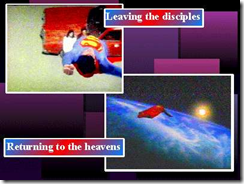
  6. Superman's five years in space echoes the Ascension
  7. Shown with weight of world/sin on shoulders
  • • At one point Superman falls towards the Earth in a pose that vaguely echoes the Crucifixion.
  • • He is stabbed in his side with Kryptonite in an echo of the stabbing of Jesus by a Roman soldier.
  • • A female nurse rushes into the hospital room to find it empty just as Jesus tomb was found to be empty by female followers.

And there are Christians in the US who believe that the symbolism is now sufficiently obvious that the film can be incorporated into religious teaching.

Stephen Skelton is the author of the Gospel According to the World's Greatest Superhero and has prepared guidance for pastors wanting to use Superman Returns in their sermons.

Sex and violence

"You would have to be blind to miss what they are doing in terms of the Christ imagery," says Mr Skelton, a Christian with a background in showbusiness, "there is a big foot in the door."

American churches have not generally been well-disposed towards Hollywood, with its laissez-faire attitude towards sex and violence. But the West Coast Babylon has recently offered two films which have been manna to churches, The Passion of the Christ, and the Chronicles of Narnia.

One or two voices have said how can we see Superman as a Christ figure when he is fooling around with Lois Lane when she is committed to another person - that simply comes from pushing the parallel too far

Stephen Skelton
Christian author

Some more traditional churchgoers may be under-whelmed by the use of movies to sell the Gospels, but Mr Skelton is unrepentant.

"That is a modern idea that we are somehow dumbing down the Gospels. This has a huge biblical precedent. In Acts 17:28 Paul quotes from a hymn to Zeus. He is using a pagan deity... the least we can do is take a second glance at Superman.

As well as the imagery, there is plenty in the dialogue. Superman refers to himself as a saviour, while baddie Lex Luthor talks about the man with his pants on the outside as a God.

Average cinemagoer

The film borrows Superman's father's speech from the first movie and gives it a prominent place, with Marlon Brando intoning: "They [mankind] only lack the light to show the way. For this reason above all, their capacity for good, I have sent them you, my only son."

But as far as the imagery goes, what is "blatant" for those with a background in Christianity, comics, art or criticism, may be a little more opaque for the average cinemagoer.

Superman

You wrote that the world doesn't need a saviour, but every day I hear people crying for one

Superman to Lois Lane

Mr Skelton says director Bryan Singer told him the scene where Superman's adoptive mother cradles him in her arms at the start of the film is a deliberate echo of images from the Renaissance of the Virgin Mary and the dying Christ such as Michelangelo's Pieta.

But it is easy to find oneself wondering whether there isn't a note of blasphemy in the film. If Superman is so clearly meant to be Jesus, why is he making goo-goo eyes at Lois Lane, who has found a long-term partner in the hero's five-year absence from the planet.

"One or two voices have said something - how can we see Superman as a Christ figure when he is fooling around with Lois Lane when she is committed to another person. That simply comes from pushing the parallel too far," Mr Skelton explains.

And Mervyn Roberts, a broadcaster and Anglican vicar, says although he has not seen the movie it is unlikely to be blasphemous or be difficult for a Church that has largely shrugged off the Da Vinci Code.

"The truth of the Gospel will come through. Superman is very much a kind of iconic image of the saviour figure that is seen throughout history.

"So the Superman movie, unless it specifically makes references to Jesus Christ in a negative sense, a direct insult to the person of Christ, identified an insult against God, it is just putting through that image."

'Gritty' gospels

But there are going to be plenty of Christians who do not find their hearts warmed by the use of religious imagery in a blockbuster. Superman hardly comes to Earth with an amazing message, and Jesus's purpose was not preventing man-made earthquakes.

Giles Fraser, parish vicar at Putney in London, says it was one thing to use the film to draw children into the Church by glossing over the "incredibly gritty" nature of the Gospels, but quite another to do it with adults.

"Using it as evangelism for adults is completely ridiculous. It is making Christianity into this rather wholesome nicely, nicely affirmation of American values, the morphing of Jesus into the American hero."

JEWISH LINKS

  • Both creators were Jewish
  • Superman and father's name sound Hebrew
  • Parable of Moses evoked
  • Condemned by Nazis
  • Story of immigration/assimilation

The black and white image of good and evil was not compatible with orthodox Christianity, Mr Fraser says.

And for all the Christian symbolism, it might be the case that there is no one religion that lay claim to the Man of Steel. Rabbi Simcha Weinstein has written a work, Up, Up and Oy Vey about the massive Jewish influence on the comic book industry particularly in its early years.

Many have noted that as well as being created by two Jewish authors, Jerry Siegel and Joe Shuster, Superman and his father's Kryptonian names both end in the Hebrew name for God, Kal-El and Jor-El, and that Superman's departure from Krypton can be taken as an echo of the story of Moses' childhood.

The Nazis went out of their way to condemn Superman, with Goebbels writing a polemic in April 1940 in Das Schwarze Korps, an SS newspaper.

Viewer's discretion

And even the Buddhists are getting in on the act. An article on the Buddhist Channel compares Superman to a Bodhisattva, "a great being who aspires to unconditionally help all beings be free from any suffering".

Danny Fingeroth, author of Clark Kent in Disguise: Jews, Comics and the Creation of the Superhero, says there is a certain inevitability to the reading of religious references into superheroes.

BUDDHIST PARALLELS

  1. Meditates above Earth
  2. Draws on Guanyin Bodhisattva
  3. Has gone on soul-search
  4. Distracted by worldly love

"While they have loaded the Superman movie with Christian imagery and dialogue it is still at the discretion of the viewer to see it that way.

"There is religious imagery because of the very nature of the superhero mythology - somebody with great powers who uses them to do the right thing.

"One of the appealing things is that while they may remind us of certain religious figures or ideas the fact that they are not of any one religion is what has allowed them to be embraced around the world.

"And if you like Superman rather than Batman it is unlikely you will get into an argument with someone and end up dead."

Tuesday, November 24, 2009

The House of El (Beth El)

Kal El

… Micah El… Michael (could these words be cognates)

Gabriel all Angels end with El, including Ang(El).

Jor – Jah  Jah-El, Yah-El… Jor-El


angel

[12] In a sense, English already had this word in Anglo-Saxon times; texts of around 950 mention englas ‘angels’. But in that form (which had a hard g) it came directly from Latin angelus. The word we use today, with its soft g, came from Old French angele (the ‘hard g’ form survived until the 13th century). The French word was in its turn, of course, acquired from Latin, which adopted it from Greek ángelos or ággelos. This meant literally ‘messenger’, and its use in religious contexts arises from its being used as a direct translation of Hebrew mal’ākh ‘messenger’, the term used in the scriptures for God’s intermediaries.

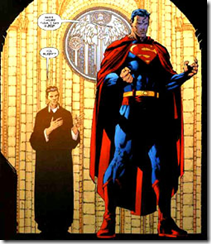
The “Canaanite El” worship appears to have syncretized with Hebrew mythology, the later perhaps evolving out of the former, and there are instanced of this evolution present in the Hebrew bible. In the earlier texts, their god is refereed to as El, or variations of the name. In Exodus 6:3-4,  their god makes this statement:
image

And I appeared unto Abraham, unto Isaac, and unto Jacob by the name of Ēl Shaddāi, but by My name Yahweh was I not known to them. And I have also established My covenant with them, to give them the land of Canaan, the land of their pilgrimage, wherein they were strangers.

This announcement of a name change appears to have been a scriptural method of converting the Canaanite followers of El to Yahweh worship. Originally, these appear to have been two separate gods, Yahweh being a sky/storm god, El a desert/creator god.


Jor-El is a fictional character from the Superman comic books, published by DC Comics. Created by American writer Jerry Siegel and Canadian-born artist Joe Shuster, he first appeared in Action Comics #1 as Superman's biological father.

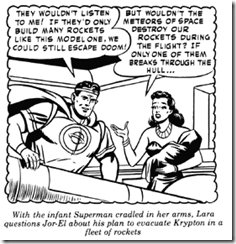
Jor-El is a Kryptonian, and the husband of Lara Lor-Van. He is a scientist and leader on the planet Krypton before its destruction. Jor-El foresaw the planet's fate, but was unable to convince his colleagues in time to save their race after his appeals. He was able to save his infant son, Kal-El, sending him in a homemade rocketship to Earth just moments before Krypton's demise

Taken from Wikipedia: Dec 2, 2009 -http://en.wikipedia.org/wiki/Jor-El

image image 
image
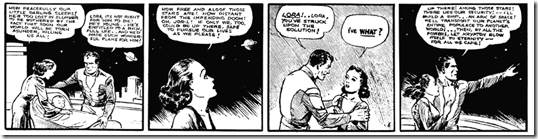
Please note on Jor-El’s chest not a RED SUN, or A SUN, or AN ‘S’ or any Kryptonian symbol but the PLANET SATURN….

Note the planet Jor-L and Lora are looking at! If you zoom this pic you’ll be able to read in the text more biblical reference to an ARK of SPACE… very Argha Noa-ish or Ark of Noah eh!
imageimage
Don’t  miss Jor-El’s crowns of thorns eh… or should we say HALO

From Krypton to Kronos

Krypton (; from kryptos "hidden")

Cronus was also identified in classical antiquity with the Roman deity Saturn. In the Alexandrian and Renaissance periods Cronos was interpreted with the name Chronos. Another theory holds that it may be related to "horned", suggesting a possible connection with the ancient Indian demon Kroni or the Levantine deity El.

In Greek mythology, Chronos (Ancient Greek: Χρόνος) in pre-Socratic philosophical works is said to be the personification of time. His name in Modern Greek also means "year" and is alternatively spelled Khronos (english transliteration) or Chronus (Latin spelling).

Chronos was imagined as an incorporeal god. Serpentine in form, with three heads—that of a man, a bull, and a lion. He and his consort, serpentine Ananke (Inevitability), circled the primal world-egg in their coils and split it apart to form the ordered universe of earth, sea and sky. He is not to be confused with the Titan Cronus.

He was depicted in Greco-Roman mosaics as a man turning the Zodiac Wheel. Often the figure is named Aeon (Eternal Time), a common alternate name for the god.

Chronos is usually portrayed through an old, wise man with a long, gray beard, such as "Father Time."

Cronus (Saturn)

Cronus (known as Saturn in Roman mythology) was the god of Time and the son of Uranus and Gaea.
Cronus' brothers and sisters were the Titans and because of a revolt against their father Uranus Cronus became the King of the Gods.
Cronus was always afraid that his kids would overthrow him so he ate them and when Rhea his wife had their last child Zeus she tricked Cronus into eating a rock instead of Zeus. Like Cronus was afraid , Zeus overthrew him with the help from his sisters and brothers.


Let us take a look into time… Sunday is the day of worshipping the Sun God, Monday, the Moon god, Tuesday , Wednesday, Friday, and Saturday is the day for worshipping Saturn the Canaanite god El

image The God Saturn/


image

Heptagram
Weekday heptagram

The order of the week days can be derived "geometrically" from an acute heptagram, the {7/3} star polygon (as 24 mod 7 = 3). The luminaries are arranged in the same Ptolemaic/Stoic order around the points of the heptagram. Tracing the unicursal line from one planet to the next gives the order of the weekdays.


The term "Sabbath" derives from the Hebrew shabbat (שבת), "to cease", which was first used in the Biblical account of the seventh day of Creation (Genesis 2:2-3)

Sabattum as the 15th day of the lunation: this word is cognate with Hebrew Shabbat, but is monthly rather than weekly; it is regarded as a form of Sumerian sa-bat ("mid-rest")

In astrological theory, not only the days of the week, but the hours of the day are dominated by the seven luminaries. If the first hour of a day is dominated by Saturn (image ), then the second hour is dominated by Jupiter (), the third by Mars (), and so on with the Sun (), Venus (), Mercury (), and the moon (), so that the sequence of planets repeats every seven hours. Therefore, the twenty-fifth hour, which is the first hour of the following day, is dominated by the Sun; the forty-ninth hour, which is the first hour of the next day, by the Moon.


Saturday: the only day of the week to retain its Roman origin in English, named after the Roman god Saturn associated with the Titan Cronus, father of Zeus and many Olympians. Its original Anglo-Saxon rendering was Sæturnesdæg (pronounced [sæ.tur.nes.dæg] or [sæ.tur.nes.dæj]). In Latin it was Dies Saturni, "Day of Saturn"; compare: French Samedi. The Spanish and Portuguese Sábado, the Romanian Sâmbătă, and the Italian Sabato come from Sabbata Dies (Day of the Sabbath).

Sunday: Old English Sunnandæg (pronounced [sun.nan.dæg] or [sun.nan.dæj), meaning "Sun's Day". This is a translation of the Latin phrase Dies Solis. English, like most of the Germanic languages, preserves the original pagan/sun associations of the day. Many other European languages, including all of the Romance languages, have changed its name to the equivalent of "the Lord's day" (based on Ecclesiastical Latin Dies Dominica). Compare: Spanish and Portuguese Domingo, French Dimanche, Romanian Duminică and Italian Domenica. In both West Germanic and North Germanic mythology the sun is personified as a goddess; Sunna/Sól

image

image
image
image

image
Revelations 1:14 … and his eyes [were] as a flame of fire.
Revelations 1:16 …and his countenance [was] as the sun shineth in his strength.

THE HOUSE OF EL
according to DC Comics

The House of El was one of the noble ruling families of the planet, Krypton. The name El translates in Kryptonian to "of the Star". The family line extends back thousands of years, to a time when tribes of Kryptonians still waged war against one another across the continents. The direct descendants of Jor-El the First sired children whom would become the sole survivors to escape Krypton's ultimate destruction - Kal-El and Kara Zor-El. The bloodline continued through the centuries with the births of Kal-El's Kryptonian/Human hybrid children with wife, Lois Lane.

The earliest known members of the El family line existed during Krypton's pre-industrial age when Kryptonians were known by only a single name. The first recorded member of the family line was Feln, who was the father of Rugad, who was the father of Tomnu. Tomnu's son, Erok became the first Kryptonian to create clan names and called himself Erok-El, or, Erok of the Star. His wife was Milia, the daughter of an opposing Bethgar named Uved. Erok-El and Milia gave birth to Kal-El the First, who became the second Bethgar of the continent of Urrika. Kal-El's son, Wab-El did not share his ancestor's noble qualities and became a vicious warlord. Wab-El had two sons, Vad-El and Hyr-El. Vad-El became a tyrant like his father, and Hyr-El disowned the family name after a feud with Vad-El. Hyr-El's direct family lineage is what eventually evolved into the modern House of El

Monday, November 23, 2009

Documentary Watch List

Zeitgeist
The Ring of Power
The Naked Truth
Religulous by Bill Maher
History of the English Language
Life & Debt
Money As Debt
BBC - The Money Trap
The Ascent of Money
Secret Mysteries of America's Beginnings I - The New Atlantis
The Truth about the Federal Reserve
The Obama Deception
THE DECLINE AND FALL OF AMERICA
The Pirates Of Silicon Valley (The story of the unethical business practices of Microsoft and Apple Computer)
The Century of Self
Home
Earthlings
We: The Documentary of the Human Race Today
The Orion Conspiracy
The Chariot of the Gods
The Esoteric Agenda
Kymatica
Bowling for Columbine
Flow: For the Love of Water
Blue Gold: World Water Wars
Consuming Kids
Deconstructing the Myth of Aids
The Origin of AIDS,Polio Vaccine: The Smoking Gun
HIV- AIDS:Fact Or Fraud
The Land of Look Behind
End Game
If Drugs Were Legal - BBC Documentary(2005)
The History of Marijuana
Aphrodisiac: The Sexual Secret of Marijuana
Union: The Business of Getting High
Marijuana Inc. Inside America's Pot Industry
Prince of Pot
Cannabis: The Evil Weed -BBC.Horizon.2009
National Geographic Explorer - Marijuana Nation
Occupation 101
Ross Kemp On Gangs: Jamaica

If we must die

image

Jamaican poet Claude Mackay wrote a poem in 1919 called, 'If we must die' in response to race riots across American cities.

It was a poem of such quality that it became an anthem of resistance everywhere.

Twenty years later British Prime Minister Winston Churchill used it as a rallying call to encourage troops in the second world war and to persuade the US to join the war.

But Prime Minister and his speech writers never attributed the words to Mackay.

BBC's Mark Coles recently discussed the poem with Jamaican poet Lorna Goodison.

LISTEN HERE

Thursday, October 22, 2009

Of Pearls & Swine in the Summer of Swine Flu

Why am I cursed so so...
So all the time,
So so so confined,
Condemned to cast cast...
Cast pearls at swine,
In a capitalist muddle,
To mingle, mix and meddle,
Damned, damned...
Damned to peddle,
My wares and what's mind,
My wares and all that's mine,
In a world of material commodity,
An intellect has and is no property,
Only to be mangled by an ancient monopoly(theist).

Now I am no sissy,
And I don't like to make a fuss,
But goddamit I feel like Sisyphus,
Up the hill with all I can muster,
Lacking shine... lacking... luster...rrrgh

Wednesday, October 21, 2009

Rasta at the Poet Tree... or is it Poet's Tree

Haiku series:


Deja's View

Madness spreads fever
Men come for the tight love grind
Nude pleasure sputters


Days of the Old Skool Yaad

Children at the skool
Shelter behind old stone walls
People everywhere


La Luna and the Lunar-cy

Some sweet god shimmers
Luminous nitefall spreads
This dream burning with lite


Homicidal Secrecy

Blind cries for deaf tears
I don't want to, but know things
So pain pours from me...


The Fear of Solitude

I sparked this madness
alone again, as always
All I know is pain.


The Sardonic Nature of God

God would laugh at me
I'm crying for no reason.
I was happy... once!


Soul-ar Eclipse

Contemplating suicide
I'm filled with disillusion
Today, my heart blackened

________________________________________

Permission to Speak Freely

If I might speak freely Ma'am,
I've been thinking on God,
And I've been keeping my guard,
I've been consuming ancient texts and toiling hard.

I don't want to talk,
But we need to speak,
And speak freely I must,
Even though I know my dry honesty causes disgust,
But I would tell thee of love and lust,
Sinking ships and broken trust,
A thought in me throbbing and growing robust,
I must place the scion of Kush in you with a thrust.


Lucea Harbour

Out on the docks,
Facing the sea,
Just behind the Public Lie Bury,

It was out on the docks
Just before dawn,
As lanterns dot the whispering, mumbling, Sssssshhhhhing secret sea...
Like peenie wallie against some big black blue damp dewed lawn,

As I hear the hushing sighs of weary waves that at long last reach shore,
As I hear the lapping of paddles and oars parting waters,
As I hear my own fingers swishing and squishing like feet playing in puddles & pools,
As I hear her parting labia label me Lord and Conqueror...
My mind is gone...
Lost in the cool morn twilight calm.


Non-Sequitur

I've got a job,
But am feeling hollow,
This a bit odd,
It does not follow.

I've forsaken street and lane,
With no tomorrow and they blow men's marrow,
But I fear supervisors and cubicles just the same,
I cannot comprehend it does not follow.


Sleepy Mornings

She's velvet black,
No not my sunshine,
Just my late lazy misty morn,
Wrapped in my rumpled sheets,
She's wrapped in an epidermal abyss,
A skin clammy with the nippy 9 am air of bleak days.

She is slumber,
She is languid,
She is limp,
She is supple,
She is my smokey sleep morning...


Julius Caesar and his Sunny Son

I've given you my five loaves and two fishes
Don't grant me platitudes and beatitudes,
Just answer me this,
If I pray... will you give me three wishes.
_______________________________________________

Thoughts before the battle! (Mental dialogue with Sun Tzu)

I've surveyed the terrain,
And my conviction remains,
I don't need Roy Forester to know which way the wind blows,
Rastafari knows how the current flows,
I've foresighted my foes,
I've visioned tomorrow,
And forecasted the future,
I will version "HIS" story,
I know I have my mathematics right,
I've been endowed the magic the mind the mettle and the might...
Vested for an eternal fight,
I have the heart and aim by sight,
With the first shot...
ONE bullet...

My hopes... my dreams will take flight.


Poethreat

I walk with a pen, a gun and a knife,
So fear me most...
For I can... kill you twice.

I write eulogies often,
I can draw you a coffin,
And I have the mind to put you in it...

For ink can steal your fame and stain your name,
Draw your caricature,
Mocking you throughout your eternal voiceless future,
Or it may...
Jot the words for your epitaph,
Something dry and witty...
Dark humour... guaranteed to make someone laugh.

I've heard it said the pen is mightier than the sword,
And God created the world with but a word.

So watch your words and deeds indeed,
As a matter of fact... watch your words and mind mine,
For I am vile new breed.

I walk with a pen, a gun and a knife,
I can kill you twice, so protect your life!

My hands know blood and ink,
So dare me to draw... dare me, just dare me to even think...

Monday, October 05, 2009

Is the Public Capable of Recognizing Quality Music?


Can the average music listener recognize quality? Can they distinguish a virtuoso from a mediocre musician? Can they recognize a “hit” that will still be esteemed a masterpiece in a hundred years? Does “popular” mean the same as “quality”?

I’ve just starting watching that great Massachusetts law drama “The Practice” again. In a recent episode, a film critic defended his occupation: “The public don’t know whether they like a movie or not unless we tell them!” Is the same true for music?

A couple of years ago The Washington Post held an experiment to find out. They called their experiment “Pearls Before Breakfast”.

The Experiment

To find his own answer to our question, Gene Weingarten from The Washington Post approached violin virtuoso and one-time child prodigy, Joshua Bell, and asked him to don street clothes and play quality music on his 1713 Stradivarius as a busker at a Washington DC railway station during rush hour.

Here is a brief summary of the experiment. You can read the original Washington Post article here, and see Dear Teacher’s take on it (including footage of the event) in the Youtube video below.

On a cold January morning, Bell arrived at L’Enfant Plaza Station at 7:15 am, and positioned himself against a wall on a busy subway platform near a trash basket. He wore jeans, a long-sleeved t-shirt and a baseball cap. He threw a couple of dollars in his open violin case, pointed it towards the passersby, and played Bach for 43 minutes with the same 3.5 million dollar violin and passion he would play with in Symphony Hall.

Weingarten describes the thoughts and decisions that passersby would have to process:

Each passerby had a quick choice to make, one familiar to commuters in any urban area where the occasional street performer is part of the cityscape: Do you stop and listen? Do you hurry past with a blend of guilt and irritation, aware of your cupidity but annoyed by the unbidden demand on your time and your wallet? Do you throw in a buck, just to be polite? Does your decision change if he’s really bad? What if he’s really good? Do you have time for beauty? Shouldn’t you? What’s the moral mathematics of the moment?

In their planning, editors of the Post discussed the issue of crowd-control, but they needn’t have bothered. A crowd never formed. What response did Bell get?

  • A $1 tip from a lady who didn’t stop to listen.
  • A middle aged man slowed his pace to listen for a few seconds before hurrying again.
  • One man leaned up against a wall to listen, but hurried off after looking at his watch.
  • A three-year-old boy tried to stop to listen, only to be pushed along by his mother.
  • A total of six people stopped briefly to listen.
  • 27 people gave him money, but didn’t stop to listen.
  • A worker at the station had no memory of a musician being at the station when he was asked later. He had been listening to his iPod.
  • Another woman did remember the violinist, but “but nothing about him struck me as much of anything.”
  • One person who stopped for a shoe shine complained that the music was too loud.
  • 1,070 people passed by oblivious.
  • There was no applause after any of the six pieces he played.
  • He made a total of $32 plus change.

But there were a few people who appreciated the performance:

  • One classical music fan and former student of the violin stopped dead in his tracks when he heard the music. He didn’t recognize Bell, but commented, “This was a superb violinist. I’ve never heard anyone of that caliber. He was technically proficient, with very good phrasing. He had a good fiddle, too, with a big, lush sound. I walked a distance away, to hear him. I didn’t want to be intrusive on his space.” He added, “Yeah, other people just were not getting it. It just wasn’t registering. That was baffling to me.” He contributed $5.
  • Another woman who learned violin as a child appreciated Bell’s gifted playing, and listened during her coffee break. “I really don’t want to leave,” she commented.
  • Right at the end, a woman who had seen Bell in concert three weeks earlier recognized him and positioned her just ten feet from him, where she remained planted until the end of the performance. “It was the most astonishing thing I’ve ever seen in Washington,” she said. “Joshua Bell was standing there playing at rush hour, and people were not stopping, and not even looking, and some were flipping quarters at him! Quarters!” She contributed $20.

Would you like to see Bell in action? Here is some footage, along with Dear Teacher’s take on the event.

Was the experiment fair? Let us know what you think. I don’t know if it proves anything, but I think there are some lessons in this story for we musicians and music producers.

Context

If I was rushing to work one morning, I don’t know if I would have stopped to listen to Joshua Bell. I can be pretty focused when rushing for a train. Once I was running to catch one, tripped, slid along the platform on my stomach until my face was up against the train’s window, and still managed to jump on.

It’s hard to learn anything from this experiment without taking context into consideration. If you want to run a successful concert with people stopping to listen, don’t hold it on a train platform during peak hour. In this context, the people’s lack of ability to recognize quality music isn’t the only issue. It’s unlikely they would risk their jobs to listen even if they did recognize the quality.

What we can learn from this experiment is that context is always an issue in how music is accepted. Whether we’re creating music for a concert, and advertisement, a soundtrack, or a computer game, that context will dictate the type of music that will be acceptable as much as any other factor. We need to answer the question, “Where will people hear this music?” and write accordingly.

Genre

Quality alone will not guarantee that music will be enjoyed. As with the fashion industry, taste plays a hugely important part – we all enjoy different styles and genres of music. Would the response have been different if the Post went with rock or pop music instead of classical music?

I’m sure that most musicians reading this article understand genre, and have strong opinions about what genres you enjoy. There are no right and wrong answers here: different people have different tastes. Understanding that, and creating music within a predicable set of genres – will increase your chances of success. Listeners who enjoy one of your tracks expect to enjoy others.

Even within a genre, fashions will change. The expected sound of a snare or bass line for a genre will vary over time. One thing I love about the tutorials here on Audiotuts is that many of them will help you tweak your music to achieve that sound.

Branding

People didn’t stop because they didn’t recognize Joshua Bell as a world-class musician. If signs were put up or announcements made on radio, I have no doubt there would have been a traffic-destroying crowd. If people were told he was famous, they would have been interested.

Branding – making a product, musician or band instantly recognizable – is a key element in marketing today. It also raises the question of this article: Are normal people able to recognize quality music without branding? Or, as the film critic on The Practice claimed, do people need someone to tell them what they like?

For producers of music, it is enough to recognize that branding and marketing are essential elements in becoming successful. We need to assume that quality is not enough, and make ourselves recognizable. What do you do to brand and market yourself or your music?

Popularity

Even more than needing an “expert” to tell us what we like, we need our friends to. Social proof is a powerful thing. Knackered Hack asks the question in his article The Lie Becomes the Truth: “Since I heard about social proof, and more specifically Joshua Bell’s famous busking experiment, I’ve wondered what in fact determines my own musical taste: how independent is it of others? Like anyone, I want to think I’m a free spirit.”

The music industry is driven by popularity, not quality. The popularity of an album defines the number of sales. The two concepts are not necessarily mutually exclusive, but musical quality is not the only thing that makes a song popular.

The likability or infamy of the artist, the humor or currency of the lyrics, image and advertising, and the amount of radio time a song gets can all contribute to its popularity. The traditional line of the record companies is that they deserve the lion’s share of the profit because achieving popularity without them is impossible.

What are your thoughts about popularity? Is it important? How is it achieved? And is it possible to achieve it by promoting and distributing your own music?

Famous Composers

Joshua Bell was not recognized as being a virtuoso by most people in the crowd rushing to work that morning. We have to wonder whether things would have been different if they weren’t in such a hurry.

But quite a few now-famous composers didn’t achieve the recognition they deserved in their own generations. They produced beautiful music for decades, but the music listeners of the time were oblivious to its quality. Their musical genius was ahead of their time.

If entire generations missed the quality of a musical composition even after hearing it for decades, what hope did Joshua Bell have that morning?

Musicians Appreciate Music Differently

It is telling that two of the three people who stopped to listen were musicians. In fact, they had spent years studying the violin—the same instrument being played by Bell—and were able to recognize his greatness by their own familiarity with the instrument and the music.

Musicians listen to music differently to others. For a start, we’re really interested in music—though that can be said of many non-musicians as well. We can appreciate when a singer or musician does something special, because we understand what is involved in accomplishing it. We have a greater awareness of the sounds of an instrument, the structure of a song, the subtle things that make a performance outstanding, the beauty of a melody, and the extra flavor added to a chord.

The music you create will be listened to by non-musicians. They probably won’t hear the same things in your music as you do. They won’t understand the skill and effort you have used to create it. They’ll just be aware of whether they like it or not. How should that affect our music making?

Conclusion

I’m not sure whether the “Pearls Before Breakfast” experiment was a fair test. But it’s an interesting story which we can learn from.

Is the public capable of recognizing quality music? Let’s hold our own informal poll:

  • Do you believe you recognize quality when you hear it? Do you believe the rest of the world does?
  • If Joshua Bell was playing at your train station, would you have stopped? Even if you couldn’t stop, would you have recognized his talent and the quality of Bach’s music?
  • If you make a mistake at a gig, how big does it have to be before someone in the audience notices?
  • How important is quality in order for music to become popular?
  • Besides quality, what other aspects are important for someone wanting to become a successful music producer?
  • What did you learn from the experiment?


Is the Public Capable of Recognizing Quality Music?
Adrian Try
Thu, 24 Sep 2009 12:43:13 GMT